

THANK YOU FOR SUBSCRIBING

Pharma Tech Outlook Weekly Brief
Be first to read the latest tech news, Industry Leader's Insights, and CIO interviews of medium and large enterprises exclusively from Pharma Tech Outlook


 Dr. Michael Gamlen, Founder
Pharma developers and scientists need to understand how the combination of drug substance, formulation and the manufacturing process affect the finished product. Changes in excipients, lubrication, processing conditions and even manufacturing environments can influence the final product in ways that are not always apparent. Understanding those relationships early gives developers a clearer picture of what may need to change as development moves forward.
The challenge becomes greater for high-value, early-stage drug substances produced in limited quantities. The real value is in getting these insights before full-scale production.
A pharmaceutical tableting and powder-compaction technology company, Gamlen Tableting brings formulation development down to laboratory scale, helping pharmaceutical scientists understand how powders behave under compression while using very small quantities of material. Its miniaturized approach to compaction science gives development teams the data to make earlier formulation and process decisions, reducing material requirements, development time and costs.
Backed by decades of compaction expertise, Gamlen Tableting supports formulation development, process evaluation and production troubleshooting. Its powder compaction technology can characterize material with as little as 100 milligrams, enabling teams to investigate compaction behavior before committing much larger quantities to development and production.
Gamlen Tableting also provides USP testing, bespoke testing packages, small-scale tablet manufacture and tableting training, with its broader expertise extending into production troubleshooting and material evaluation. Keeping material science and compaction at the center of its own expertise, it brings in trusted specialists for analytical development, dissolution methods and measurements outside its core discipline.
 “We miniaturize the formulation development process and make it economical,” says Dr. Michael Gamlen, founder. “Our clients have the double benefit of saving time and material while gaining a better understanding of how their formulation behaves during development.”
Gamlen Tableting carries out this work in its own laboratory, where powder compaction analyzing instruments in its D-Series—the D500 and the D1000—provide the foundation for testing and formulation development. D500 is designed primarily for small tablets of 4 mm and less, with 500 kg as the maximum compaction load. D1000 is used for tablets up to 10 mm and handles compaction load up to 1000 kg. D-Series facilitates fully automated compaction analysis, preventing data entry errors and ensuring fast, consistent analysis.
The business model is central to this approach. Under a licensing agreement, Fette Compacting holds the pharmaceutical sales rights for the instruments while Gamlen Tableting continues to apply the technology through its own laboratory.
Where the science began
The foundation for Gamlen Tableting’s powder compaction comes from a reputable history in tablet development.
With a PhD in compaction from the University of Nottingham, Dr. Gamlen began his career at Beecham Pharmaceuticals, where he instrumented a rotary tablet press. Later, he was head of tablet development at the Wellcome Foundation, where his relatively small team was handling around 20 products at the same time. A compaction simulator provided valuable information, but such equipment was rare and expensive.
Our intention is to give development teams greater confidence that a formulation will work when it reaches production.
The experience shaped his interest in bringing powder characterization to the bench scale.
Dr. Gamlen developed the analyzer to study compaction behavior using very small quantities of material. It was subsequently adopted by major pharmaceutical companies, and Gamlen Tableting’s compaction analysis became relevant not only to formulation development but also to process development and troubleshooting. Gamlen Tableting’s D-Series continues to support applications, including alternative supplier evaluation and process or formulation change evaluation.
Gamlen Tableting’s testing methodology combines compaction science with a semi-automated system for determining the required tests, generating the data and understanding how changes in formulation and process affect product quality.
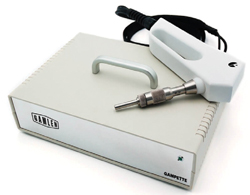 Helping clients understand the relationships between compaction pressure, solid fraction and tensile fracture stress forms the core of its methodology. Gamlen Tableting’s broader laboratory studies go beyond these core compaction measures to examine properties such as lubrication, friability, disintegration and dissolution. For data on measurements such as density, surface area and particle size, it works with specialist partners.
This analysis data underpin its troubleshooting investigations, which begin by identifying what changed when a process stopped performing as expected. The change may involve material or API properties, engineering, purchasing, specifications or air-conditioning limits in the manufacturing unit. By examining these factors from different angles, Gamlen Tableting helps clients trace a manufacturing problem back to the change affecting product quality. This can include analyzing submitted samples for compressibility and comparing various suppliers of excipients and APIs to understand differences in material behavior and identify potential causes.
Making Compaction Behavior More Understandable
As pharmaceutical scientists have placed greater emphasis on objectively characterizing compaction behavior, USP has provided an important framework for tablet compression characterization. Gamlen Tableting’s USP service calculates compressibility, compactibility and tabletability, and its broader testing can assess lubrication and elastic recovery.
It also examines the relationship between tablet porosity and strength, helping clients understand how formulation and process changes affect tablet performance. Gamlen Tableting is seeking to extend the scope of this science to address lubrication.
Although USP is not yet a regulatory requirement, Gamlen Tableting is already seeing increasing demand for the analysis, including from pharmaceutical companies as a part of outsourcing decisions.
Taking Formulations Closer to Production
Hundreds of clients have applied Gamlen Tableting’s powder compaction analysis and attained valuable results.
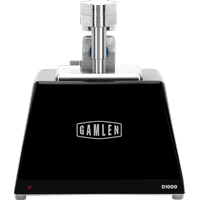 Its speed and service-focused model are what clients value the most. Gamlen Tableting reviews results quickly and maintains daily contact with clients during analysis, sharing data as it is generated. For production troubleshooting, it guarantees a response and recommendations within 48 hours, helping manufacturing teams move quickly from identifying a problem to understanding its likely causes and next steps.
“Our intention is to give development teams greater confidence that a formulation will work when it reaches production,” says Dr. Gamlen.
The next stage of Gamlen Tableting’s development is a method to develop compacted formulations faster. It is building on an existing laboratory mill and tablet film coater, adding a laboratory-scale roller compactor and single-punch tablet press.
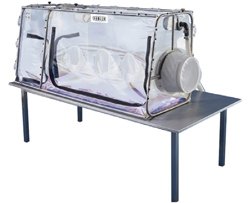 In the new model, a formulation can first be characterized using the powder compaction analyzer, evaluated using a singlepunch tablet press and then taken toward roller compaction.
The capability is particularly relevant because the industry has shifted toward dry-granulation processes. In roller compaction, powder is compacted between rollers to form a ribbon, which is then milled into granules before being compressed into tablets. The properties created during the first compaction can influence how the material behaves during subsequent processing, making it important to understand the material at each stage.
Gamlen Tableting’s service methodology is designed to examine those effects on a small scale. An ongoing client project illustrates how it applies this methodology. The team is evaluating a capsule formulation for its suitability for roller compaction, examining properties, including compactibility, compressibility, disintegration and friability.
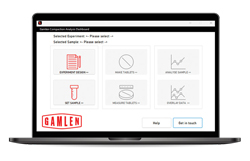 The project is set to progress into roller-compaction sensitivity testing. As part of the planned sequence, the material will be milled using an industry-standard Quadro Comil, blended and compressed first on a single-punch tablet press and then on a rotary tablet press.
Building a Legacy of Smarter Formulation
A combination of scientific understanding and practical testing will define Gamlen Tableting’s next chapter. It is creating a more informed pathway toward production-scale manufacturing. It is also preparing to launch Better Tablets, a service offering that will build on its laboratory capabilities and formulation development expertise.
Dr. Gamlen’s long-term objective is about more than compaction data. He describes the legacy he wants to build in straightforward terms; continuing to provide clients with a better understanding of compaction and its impact on product development. His long-term goal is to make compaction science more useful to the commercial realities of pharmaceutical development and manufacture.
Gamlen Tableting is named the Tablet Compaction Analyzers System of Year in UK 2026, for bringing compaction science to laboratory scale and applying it to formulation development, process evaluation and production troubleshooting.
Company
Gamlen Tableting
Management
Dr. Michael Gamlen, Founder
Description
Gamlen Tableting helps pharmaceutical scientists understand powder compaction and formulation behavior using very small quantities of material. Its services span formulation development, USP <1062> testing, process development and production troubleshooting, combining compaction science with small-scale testing to reduce material requirements, shorten development time and support more robust tablet manufacturing.

