
THANK YOU FOR SUBSCRIBING

Pharma Tech Outlook Weekly Brief
Be first to read the latest tech news, Industry Leader's Insights, and CIO interviews of medium and large enterprises exclusively from Pharma Tech Outlook

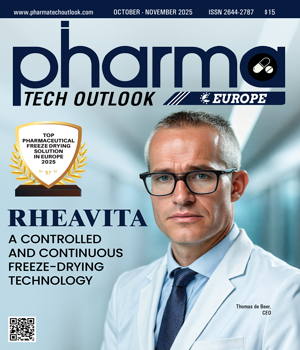
 Thomas de Beer, CEO
RheaVita is addressing this challenge head-on with RheaLyo, its continuous freeze-drying system. Instead of treating it as a static, stop-start batch process, RheaLyo runs as a seamless, integrated cycle.
“We believe every patient deserves timely access to safe, high-quality injectable medicines,” says Thomas de Beer, CEO. “With RheaLyo, the leap in speed and control turns that belief into practice.”
How does it work? RheaLyo combines two innovations. Spin-freezing ensures uniform ice formation across vials. Real-time, non-contact monitoring gives manufacturers continuous individual product quality control. Together, these tools eliminate vial-to-vial variability. What once took days can now be completed in hours without compromising stability or reproducibility.
For drugmakers, the payoff is clear; shorter time-to-market, fewer batch failures and confidence that every vial meets the same high standard. Patients gain access to life-saving medicines more quickly and in a more reliable supply.
From Lab to Launch: Freeze-Drying Without the Disconnect
One of the biggest bottlenecks in drug development has long been the handoff from formulation to manufacturing. A batch freeze-drying recipe designed in an R&D lab often falters when scaled for GMP production, forcing costly rework and sometimes compromising product integrity. For biologics and cell-based therapies, that disconnect is a barrier to timely patient access.

By working with IMA Life, we can combine their manufacturing expertise with our innovation to deliver consistent quality, greater efficiency and the flexibility clients need to meet future market demands
Scalability without compromise makes the technology stand out. Scientists begin with RheaLyo Mono, a compact R&D unit for designing and refining recipes in the early formulation stage. As projects advance, those same recipes move directly into the RheaLyo GMP-Flex, a full-capacity, GMP-compliant system with no re-engineering or re-validation required. With more operational freedom, teams can fine-tune ice crystallisation, test multiple formulations in a single day and access next-day analytics to guide decisions.
Freeze-drying has long been one of the most manual and labour-intensive steps in sterile pharmaceutical manufacturing. RheaLyo eliminates this dependency on human intervention by shifting to a fully operator-free model. Intelligent automation replaces manual steps, optimising drying parameters in real time and ensuring uniform product stability across batches. Even critical stages such as vial loading and unloading are automated, reducing variability and enhancing sterility assurance.
This approach is directly aligned with the updated Annex 1 of EU GMP guidelines, which call for minimising human involvement in aseptic processing to lower contamination risk. Beyond compliance, the automation provides measurable operational gains: consistent batch quality, improved process reproducibility, reduced downtime and long-term cost savings. In effect, RheaLyo transforms regulatory expectations into a strategic advantage.
Another advantage is its shelf-less architecture, which eliminates the need for silicone oil entirely. This removes a common source of contamination and eliminates the need for leak detection or stopper placement. Without mass transfer coefficient (Kv) calculations or primary drying resistance (Rp) determinations, the system relies instead on integrated proportional integral derivative (PID) control loop that regulates drying parameters in real time guaranteeing that collapse temperature is never exceeded. Cooling rates of up to 50°C per minute give manufacturers the ability to fine-tune ice-crystal morphology for optimal product stability. These capabilities translate into ease and fast one-on-one scale-out, fewer trial runs and faster regulatory approvals.
The RheaLyo technology leads to consistent, thin-layer cakes that are ideally suited for AI-enabled automated visual inspection, without destructive testing. For MSAT, manufacturing and quality control teams, this vial-level visibility offers a new degree of clarity where deviations are easier to detect. Regulators also benefit from this approach, gaining access to verifiable records of product conditions across the entire cycle.
Speed defines RheaLyo as much as control. With drying cycles completed in under three hours, scientists can perform multiple development runs in a single day. GMP-Flex lines then bring the same flexibility to production. Therapies and vaccines reach patients faster while operational costs remain contained.
Stable Results, Even at Room Temperature
For advanced therapies, stability can be the difference between a scientific breakthrough and a commercially viable medicine. Ultra-cold storage has long been the default solution, but it comes with steep costs, logistical hurdles and limited accessibility.
RheaLyo addresses this challenge with a continuous, precisely controlled lyophilisation process that keeps sensitive products stable without cryogenic dependence. Maintaining formulations at refrigerated or even room temperature simplifies distribution and accelerates access without compromising efficacy.
“Our technology keeps high-value drugs and vaccines stable without relying on costly cryogenic solutions, giving clients a more efficient, sustainable path to market,” says Jos Corver, CTO. “With validation across some of pharma’s most sensitive products, manufacturers can move forward with complete confidence in the integrity of every dose.”
The results speak loudly. In RheaVita’s own trials, lyophilised mRNA lipid nanoparticles (LNP) retained transfection efficiency over time at room temperature, demonstrating both extended shelf life and robust product integrity. Beyond mRNA, RheaVita has validated RheaLyo across other sensitive modalities including adeno-associated viruses, antibodies and human cells.
External validation reinforces this promise. At the 9th Annual CCP Summit, Sanofi presented findings showing RheaLyo’s compatibility with continuous mRNA-LNP manufacturing. Combining the self-assembling nature of LNPs with RheaLyo’s stability-enhancing process and real-time process analytical technology (PAT) monitoring, manufacturers can optimise production and generate the data needed to speed regulatory review.
What Lies Ahead
RheaVita is positioning its continuous freeze-drying technology at the forefront of the pharmaceutical industry’s future. The company has formed a strategic partnership with IMA Life, the aseptic processing division of the IMA Group, a global leader in pharmaceutical production solutions. The collaboration combines financial investment with technical and commercial support to accelerate global development and adoption.
“Our goal is to make continuous freeze-drying the new standard for producing valuable biopharmaceuticals,” says Alain Segers, CCO of RheaVita. “By working with IMA Life, we can combine their manufacturing expertise with our innovation to deliver consistent quality, greater efficiency and the flexibility clients need to meet future market demands.”
Beyond commercial adoption, RheaVita is advancing innovation through research partnerships. With Ghent University and CEPI, it is exploring how spin-freezing could eliminate the need for frozen storage of mRNA vaccines, enabling scalable responses to future outbreaks in as little as 100 days. As a member of LyoHUB, it also contributes to a global network advancing lyophilisation science and technology.
By redefining freeze-drying as a continuous, precisely controlled process—and surrounding that innovation with the right partners—RheaVita is helping the industry work smarter, produce drugs faster and bring care closer to patients.
The future of modernised freeze-drying is already here and with RheaVita, it is within every scientist’s reach.
Company
RheaVita
Management
Thomas de Beer, CEO and Jos Corver, CTO , Alain Segers, CCO
Description
RheaVita’s RheaLyo is a continuous, operator-free freeze-drying system pairing spin freezing with contactless, real-time monitoring to optimise cycles, ensure uniform stability and finish in hours, not days, boosting throughput, reducing batch failures and speeding reliable access to safe injectable medicines.